
Today, I will be discussing the mind-bending challenges of dyslexia and severe reading disabilities. “Dyslexia is a specific learning disability that is neurobiological in origin. (Hudson, High, and Otaiba).” It is a language-based disability. As a NJ certified reading specialist, I have explored many types of instruction to help my students who are struggling readers; Consistently, I have used multi-sensory tools combined with a systematic approach to remediation.
In this article, I am going to report some information from scientific studies. However, I caution readers to not interpret the results as a complete and comprehensive conclusion. Dyslexia, reading disabilities, and brain imaging are in the early stages of inquiry. Some prior studies support the idea that instruction that matches left brain aptitude is a successful intervention. Typically, reading programs with systematic, explicit instruction in phonics, spelling, and fluency are lauded for their success.
In a study of dyslexic and typical children followed from kindergarten through age 20, unsuccessful readers (both dyslexic and typical) consistently showed less activity on the left side of the brain. Successful readers’ images had a busier left brain activation. “ In contrast, the improved dyslexic readers bypassed this area entirely.” Their brain scans showed more activation on the right side of the brain for meaning making processes. Sally Shaywitz and other researchers feel the evidence is strong for using instructional activities that tap into creative and multi-sensory right brain areas to teach children with dyslexia.
 (Filed under Dyslexia Research, General Information Author Website: http://www.dyslexia.com Abigail Marshall)
I have purposely presented you with 2 conflicting types of evidence about left and right brain activation. Often, commercially branded systematic reading programs tend to put emphasize on left brain research on their websites. On the other hand, branded multi-sensory commercial programs quote right brain research on their websites. The unspoken secret is that most of the research for either side is legitimate. My interpretation of the research is that there is room for any type of strategies that work for each individual. In general comprehension literature, all children benefit from a variety of approaches other than worksheets, copying and rote instruction.
In this vein, I often customized my activity for each student. Some students do respond well to visual tools that support their visualization in reading and writing. Below is an assignment that seemed to work well for one of my dyslexic students. I asked him to pair a written prompt with both a visual depiction and a written explanation. Sometimes abstract concepts work well visually in a storyboard format. In this example of my student’s visualization work, he utilized his prior knowledge, symbolic thinking, personal perspective, and used critical thinking skills to express a deep understanding of the phrase: “All men should be treated equally.”
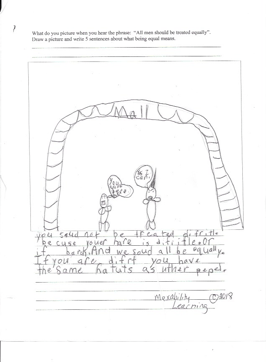
Left Bubble: “YOU CAN’T BE HERE.” Right Bubble: “YES I CAN.”
Caption: “You should not be treated differently because your hair is different or black. And we should all be equal. If you are different you have the same rights as other people.”
Conclusion:
I strongly believe in the power of accessing the right side of the brain as much as possible, which connects reading, visualizing and the thinking process.
Research has shown that, “Users may create images in order to identify relationships, main ideas, and patterns thus facilitating concept attainment and critical analyses of reading materials (Sadoski, & Paivio, 2001).
Conclusion:
I strongly believe in the power of accessing the right side of the brain as much as possible, which connects reading, visualizing and the thinking process.
Research has shown that, “Users may create images in order to identify relationships, main ideas, and patterns thus facilitating concept attainment and critical analyses of reading materials (Sadoski, & Paivio, 2001). “
REFERENCES:
Brown, C. A., Banas, J. R. Open Source Visualization Tools to Enhance Reading Comprehension and Concept Attainment. Available online: https://members.aect.org/pdf/Proceedings/proceedings10/2010I/10_07.pdf
Hudson, R.F., High, L. Al Otaiba, S. Dyslexia and the brain: What does current research tell us? The Reading Teacher, 60(6), 506-515.

